Description
Periodical Press in Goa and Goan Periodical Press
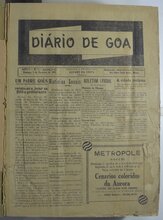
In Goa, journalism dates back to December 22, 1821 with the foundation of the Gazeta de Goa, published by the local revolutionary government after the liberal revolution of August 24, 1820 in Portugal. As an official organ, the Gazeta lasted until 1826, and ceased in counterrevolutionary environment. New titles in Goa would come to light only in 1835, after the liberal victory and the appointment of the native politician Bernardo Peres da Silva as Prefeito (Prefect) of India.
The first native Indian political newspaper published in Bombay was the liberal Mensageiro Bombaiense (1831-1832). Between 1835 and 1837 followers of Peres da Silva's - who was forced to exile by military and civil servants refusing the rule of a native - founded other titles. During the same period, several titles against Peres appeared, and the respective controversies extended to the metropolitan press.
After decades of practical typographical monopoly by the Colonial State, through the National Press of Nova-Goa, the first private typography appeared in 1859 at the initiative of a former native deputy, Constâncio Roque da Costa, for the publication of the newspaper O Ultramar (Margão). From this period on we can see a real "explosion" of the press in Goa, if we consider the size and population of the territory; the same occurred to Goan press published outside Goa. In 1900 O Heraldo began, the first daily newspaper published in a Portuguese colony, and today the oldest surviving in India, in English edition.
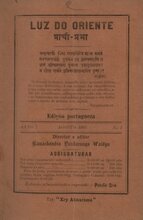
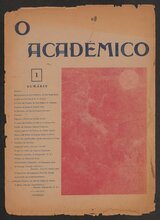
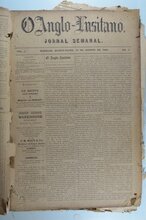
Until December 1961, at the end of the Portuguese rule in Goa, hundreds of titles circulated, ephemeral and long-lasting, published in Goa by intellectuals and politicians from diverse origins and political and cultural positions, in an atmosphere of greater freedom or of political repression. Dozens of titles appeared in other Indian territories, in Portugal, Macau, Portuguese and British colonies in Africa, and in other areas of Goan emigration. We refer to periodicals mostly in Portuguese, but also to many titles in English, Marathi and Konkani, many of them bilingual and even trilingual.
As in other cases of this exhibition, the selected titles cover a broad temporal spectrum and reflect some of the diversity of this press, more than targeting its major newspapers and magazines. We aim to underline the importance of mapping surviving collections in close collaboration between institutions and researchers. As with other spaces, the effort to survey various collections has considerably aided a deeper knowledge of the editorial history of some titles.
Notes: The information regarding the Goa State Central Library results from Sandra Ataíde Lobo' investigation in that library.