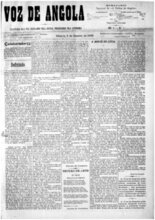
Description
During the government of Pedro Alexandrino da Cunha, on the 13th September 1845, it was published the first number of Boletim do Governo Geral da Província de Angola (Report of the General Government of the Province of Angola). Some years later, in 1856, the first non-official press initiative happened with the publication of A Aurora (The Dawn) in Luanda, founded by public administration workers, members of the military and lawyers. However, the news and independent press came to light in 1866 with A Civilisação de África Portuguesa, Semanário dedicado a tratar dos interesses administrativos, económicos, mercantis, agrícolas e industriais da África portuguesa, particularmente de Angola e S. Thomé (The Civilization of Portuguese Africa, a weekly newspaper dedicated to administrative, economic, commercial, agricultural and industrial interests of Portuguese Africa, particularly Angola and S. Tomé).
The progress of the Portuguese colonial project, the deconstruction of African societies inland and the weakening of the Afro-Portuguese elite in the urban centres have contributed to the rise of contradictions between Europeans and Africans. In such set, in 1880-90 the African press got stronger: it defended the Republic, it battled for the independence of Angola, and fought for the rights of African peoples and for their equality in relation to Europeans. However, the Government pursuit to newspapers and journalists, especially towards the newspapers which were property of Africans, led to the weakening of press and the dismantlement of many newspapers and magazines during those years.
During the Republican period, the native press also lost its protagonism due to conflicts between the "sons of the country" and the European elite. In fact, the press mirrored these conflicts and the projects of the colonial groups in Angola. There were lesser and lesser publications though, which deeply marked the sector, which was justified by financial difficulties and political pressures, especially from the government. There appeared, however, publications which assured their position until 1974. Also, one must stress the continuity of regionalization, with the creation of new titles and the press consolidation in Benguela, Moçâmedes and Malange.
With the dictatorship and the New State emergence, the censorship regulated the press of Angola making it follow the dictates of the authoritarian regime. Many publications came to light in Luanda and the inland regions, which included information, opinion and entertainment. If there was a press that moderately criticised the New State centralised laws and protectionist dictates, it also had to cohabit with the other type of press – the one which supported the political project of Salazar. One should not forget that the African population disappeared from the journalistic content during the dictatorship.
The governments, be it urban, general or local ones, were decisive in the journalistic agenda, because the political contents reported directives, plans, speeches and actions without any questioning or criticism and, most of the times, effusively. The propriety upon newspapers, linked to economical groups that supported the regime, was also a means of State intervention within the press.